Ascension
Solo Exhibition at Lakeeren Contemporary, Grand Hyatt, Santacruz, Mumbai
6th January – 28th Feb 2026
Ascension: Flight, Freedom, as Ecological Praxis
Ascension is an exhibition about flight-not as escape, spectacle, or conquest, but as an ethical and ecological act. In Sarika Bajaj’s solo exhibition, flying becomes a proposition for freedom that resists the extractive logics of patriarchal power and environmental exploitation. Situated within the intensifying realities of climate crisis, biodiversity loss, and material exhaustion, Ascension reimagines upward movement as a form of care: a way of rising that remains accountable to the earth rather than detached from it.
Historically, ascension has been aligned with dominance-verticality as hierarchy, progress as conquest, flight as transcendence over land and body. Bajaj disrupts this lineage. Her practice proposes a feminist and ecological reconfiguration of verticality, where ascent is slow, relational, and grounded in embodied labour. Freedom here is not weightlessness but responsibility; not escape from the world, but deeper entanglement with it.
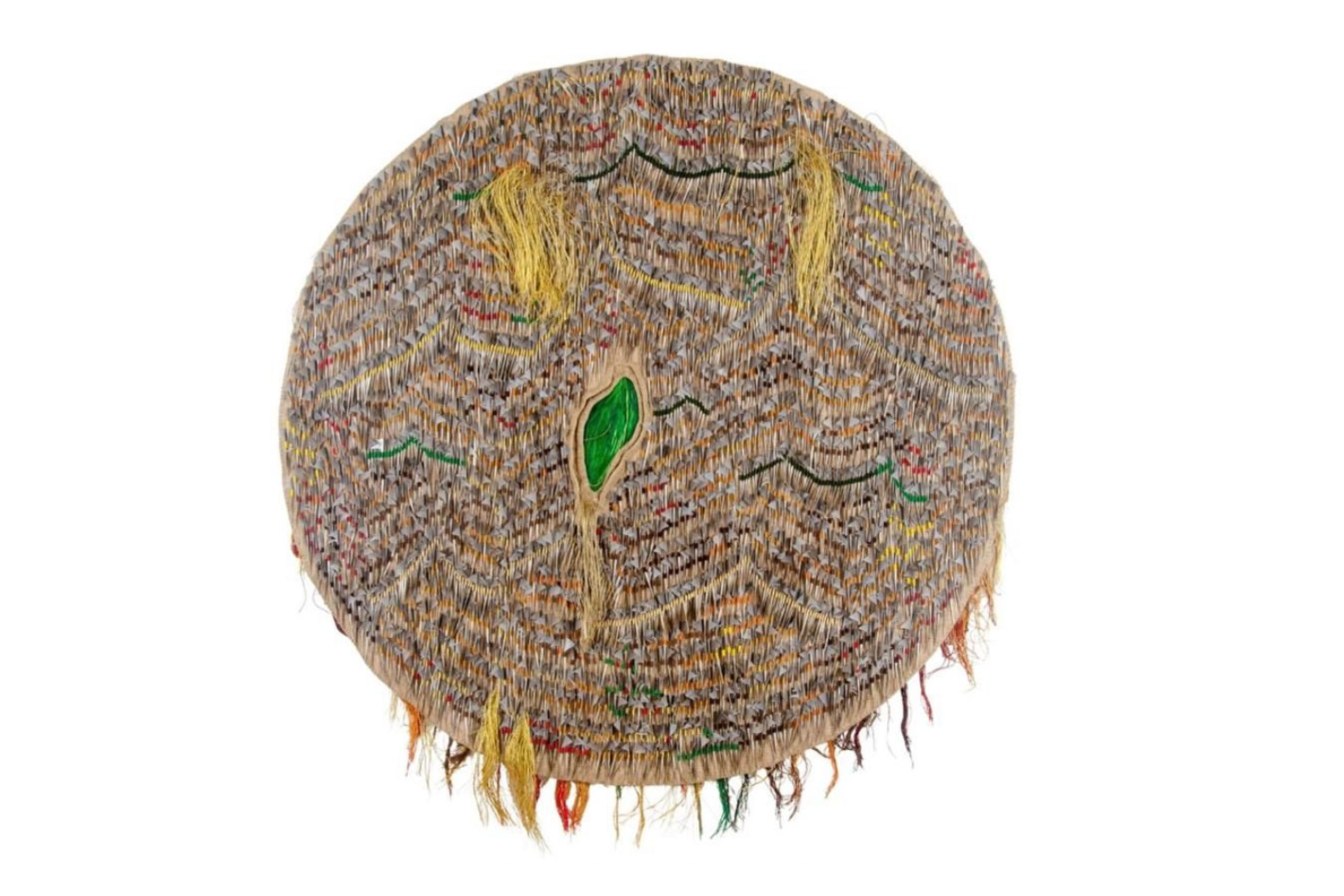
At the centre of Bajaj’s material language is the feather-an object shaped by evolution, aerodynamics, and fragility, and inseparable from the life of birds whose survival is increasingly threatened by climate change. In Bajaj’s work, feathers are not romanticised symbols of flight but ecological traces, carrying the memory of species, habitats, and atmospheric systems. Through acts of knotting, weaving, binding, and accumulation, she situates flight within practices of care, repair, and maintenance-forms of labour historically feminised and rendered invisible.
Bajaj’s process is durational and meditative: collecting, sorting, cutting, tying. These gestures resist the acceleration and disposability that define late capitalist culture. Slowness becomes an ecological and feminist stance-a refusal of extractive time and a commitment to cyclical rhythms. Rather than linear narratives of progress or apocalypse, her work aligns with ecological temporalities of regeneration, decay, and renewal. Resilience is articulated not as recovery from damage, but as sustained adaptation within fragile systems.
In her textile and tapestry works, feather quills surface and recede within rhythmic fields of thread, membrane, and fibre. Often partially camouflaged, they appear absorbed into the structural logic of the work itself, as if the capacity for flight has been internalised rather than performed. Subtle chromatic threads puncture the muted palette of jute and quill, producing a natural geometry that echoes cellular structures, migratory patterns, and organic systems. These are not forms imposed upon nature, but forms that emerge through collaboration with it.
Throughout Ascension, Bajaj foregrounds the body as a site of ecological knowledge. The works demand a haptic, embodied engagement-one that unfolds through breath, rhythm, and movement rather than distance or mastery. Texture becomes terrain; surface becomes passage. This embodied encounter reflects eco-feminist critiques that challenge the separation of mind and body, culture and nature, human and non-human.
Drawing upon indigenous and cosmological frameworks in which time, ancestry, and matter flow through the body and across species, Bajaj imagines subjectivity as porous and interdependent. Positioned between artist, archivist, and shamanic figure, she renders visible the hidden orders within ecological chaos-not to impose control, but to acknowledge interconnectedness. Flight, in Ascension, is therefore both upward and inward: a vertical alignment between earth and atmosphere, body and biosphere, memory and futurity.
The works in Ascension do not promise transcendence or escape from ecological crisis. Instead, they propose ascension as an eco-feminist ethic-one rooted in care, relationality, and accountability to fragile environments and shared futures. In a world increasingly pulled downward by extraction, extinction, and patriarchal systems of power, Bajaj asks what it might mean to rise otherwise: attentively, collectively, and without leaving the earth behind.
Dr Arshiya Lokhandwala